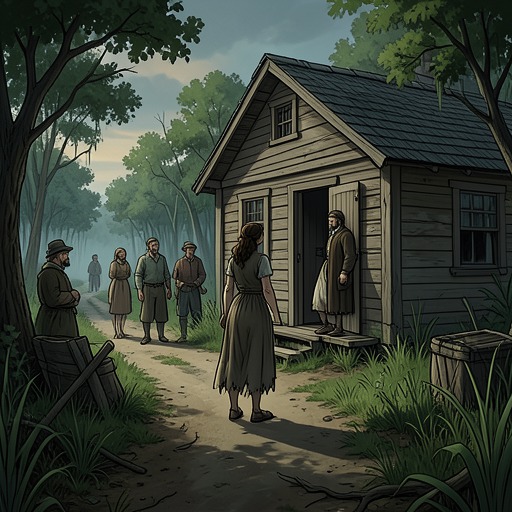
Patti Love Andrews
Where the Crawdads SingPatti Love Andrews, Chase Andrews’s mother, enters the investigation by reporting that a shell necklace he wore for years was missing from his personal effects. The object links Chase to the Marsh Girl, a relationship Patti Love had concealed or denied in public; she turns that connection into a murder accusation, though the sheriff cautions against treating her suspicion as established fact. Her testimony advances the case while exposing how grief, rumor, and social contempt shape the evidence she offers.
Identity and Introduction
Patti Love first reaches the investigators by telephone, telling them she has something important to report about a shell necklace Chase wore regularly. She asks to come in and explain why she believes it matters. When she arrives at the sheriff’s office in 1969, her appearance is visible through the frosted glass before the men recognize her: she wears a black dress and hat, her graying brown hair arranged in a tidy bun, with lipstick in a subdued shade. The careful presentation marks the visit as solemn, while the necklace gives it a specific investigative purpose.
Ed Jackson welcomes her and offers coffee; Joe Purdue brings her a chair. Patti Love declines the coffee and immediately asks whether they have found any leads or learned more since the laboratory report. She is not simply supplying information at the investigators’ invitation: she wants an account of the case and insists that Chase’s death was not an accident. In her view, his athletic ability and intelligence make it implausible that he simply fell from the tower. Ed Jackson replies that there is enough evidence to suspect foul play, but stresses that the investigation remains unfinished and nothing is definite.
The Missing Necklace
Patti Love reconstructs the necklace’s last known appearance from the evening Chase went to the tower. She says that she and her family had him over for dinner, while Pearl Stone could not attend because of her bridge night. Chase wore the necklace before he left. Later, when the family saw him at the clinic, it was no longer on him. At first Patti Love assumed that the coroner had removed it, and she did not raise the matter amid the funeral arrangements.
The absence became a concrete concern only when she went to Sea Oaks to look through Chase’s personal effects, which had been retained for laboratory work. She wanted to hold the things he had worn on his final night. The necklace was not among them, and the coroner told her he had neither removed it nor seen one. This sequence matters: Patti Love distinguishes what she initially assumed from what she later checked, and her visit to the coroner’s office turns a remembered detail into a reported discrepancy.
She describes a single shell threaded on rawhide, long enough to pass over Chase’s head, secured with a knot. In response to the suggestion that it might have come loose in the fall, she says it was not loosely tied and doubts it could have been flung away. Ed Jackson agrees that rawhide and a firm knot would make accidental loss less straightforward, but the conversation does not establish what happened to the necklace. Its missing presence is a clue that prompts further inquiry, not proof of how Chase died or who took it.
The Relationship Patti Love Reveals
Asked who made the necklace and why Chase wore it, Patti Love falls silent and looks away from the sheriff’s desk. The narration explains that she dreads saying more: she had never admitted that her son was involved with someone she regarded as “marsh trash.” Village rumors had linked Chase and the Marsh Girl for more than a year before his marriage, and Patti Love suspected the relationship continued afterward. When friends asked about the stories, she denied them. Her testimony therefore reverses her earlier public stance, not because she has become accepting of the relationship, but because she now believes it bears on Chase’s death.
Patti Love identifies the maker as the woman who had spent years boating in an old, rattling boat and selling mussels to Jumpin’. She does not know the woman’s name, saying that people call her the Marsh Girl. The sheriff confirms that he understands whom she means. Patti Love then supplies the relationship history: the woman made the necklace and gave it to Chase while they were seeing each other. The detail gives the absent object an intimate origin. It was not merely one item among Chase’s effects; according to Patti Love, it was a gift from a former partner, and she says he had worn it for years.
Accusation and Investigative Significance
Patti Love’s account shifts from observation to inference. She reasons that the Marsh Girl was the only person with an interest in taking the necklace, and connects its disappearance to Chase having ended their relationship and married Pearl Stone. From this, she proposes that the woman may have killed him and taken the necklace. The claim is hers: the evidence presented in the interview establishes that the necklace was reportedly absent and that Patti Love identifies its maker, but it does not independently establish that the Marsh Girl removed it or killed Chase.
Her conviction is tied to more than the necklace. The narration says she had already come to believe the woman was involved in Chase’s death and describes her contemptuous view of her. When she makes the accusation, Patti Love trembles slightly before catching her breath. Ed Jackson calls the information important and worth pursuing, then warns her not to get ahead of the investigation and asks whether she is certain the woman gave Chase the necklace. That response preserves the distinction between a potentially useful lead and a proven motive or act.
Patti Love’s role is thus both evidentiary and revealing. She brings investigators a specific absence, a material description, and a history that she had previously kept at a distance in public. At the same time, the story shows how quickly she converts that history into a theory of guilt. The necklace opens a new line of inquiry into Chase’s life, while Patti Love’s certainty remains something the investigators must examine rather than accept as the answer.